Pakistani Moonstone: Quality Factors, Applications and Export Potential
Moonstone from Pakistan appeals to jewelers, lapidaries, collectors and traders looking for a steady supply of a gem with a distinctive glow. Yet moonstone rewards close inspection and punishes assumptions: two parcels sold under the same name can differ sharply in sheen, clarity and cutting potential. This article explains what moonstone is, how its quality is judged, where it is used and what the export picture looks like for Pakistan, including a recent policy change that buyers should understand.
What Sets Moonstone Apart
The Gemological Institute of America describes moonstone as a variety of the feldspar-group mineral orthoclase, made up of two feldspars, orthoclase and albite. As the mineral cools, these intergrown minerals separate into thin, alternating layers. Light entering between those layers scatters, creating adularescence, the misty glow that seems to roll across the surface as the stone moves.
GIA also notes that other feldspars can show the same effect. Rainbow moonstone, for example, is actually a variety of labradorite, and sanidine can produce moonstone-like stones too. The trade name therefore describes an appearance as much as a precise mineral identity, which is worth remembering when you read a supplier’s description.
How Moonstone Quality Is Assessed
Moonstone quality is judged through several visual features at once. Daa Minerals says it reviews moonstone by colour, optical response, transparency, inclusions, surface condition, shape and buyer-defined sizing, the same factors most professional buyers weigh.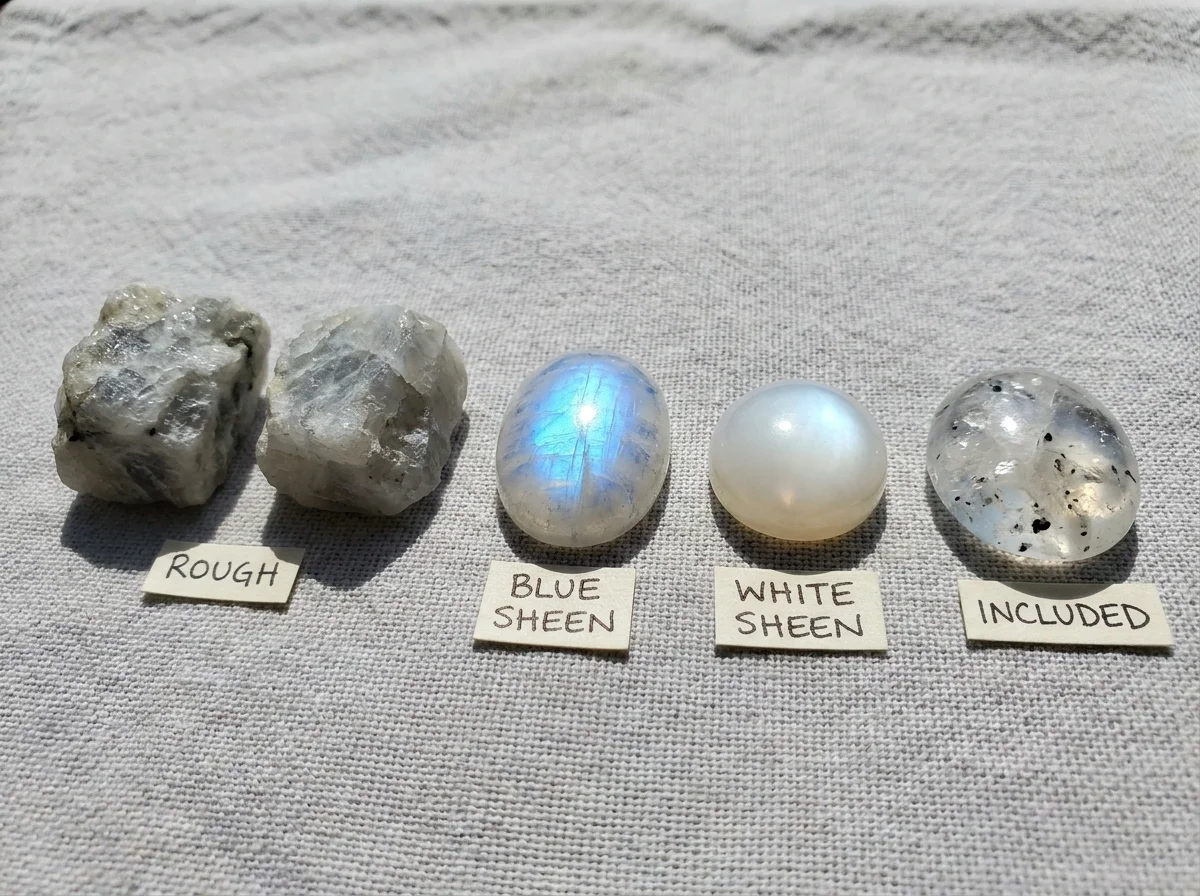
Adularescence
The strength, colour and visibility of the sheen usually come first. GIA notes that a blue sheen against a colourless background is a prized combination.
Body Colour and Transparency
Body colour ranges widely, and clearer material presents the sheen differently from cloudy or translucent stone.
Inclusions and Surface Condition
These affect both beauty and durability, particularly in rough, where cracks or surface damage influence what can be cut.
Cut and Orientation
GIA observes that the shimmer is apparent even in rough and is maximised by a quality cut. For rough, both the supplier’s selection and the cutter’s skill matter.
Size and Consistency
For parcels, uniformity across the lot matters as much as the best individual piece.
Rough, Cabochon and Finished Moonstone
Moonstone is traded in three broad forms. Rough offers the lowest processing cost but carries yield uncertainty. Cabochons, the smooth domed cut that shows adularescence well, let buyers judge the effect directly. Finished stones are ready for setting. Each form needs different packing, different checks and a different customs description, so state the form you want at the outset.
Common Uses of Moonstone
Daa Minerals lists jewellery, lapidary, decorative use and collection as the contexts in which its moonstone may be reviewed. In practice, that covers a familiar set of buyers.
Jewellery makers use cabochons and calibrated stones in rings, pendants and earrings. They care about consistent sheen and sizes that fit standard settings.
Lapidaries and cutters buy rough to shape and polish. They look at colour, clarity and orientation, because the sheen depends on how the stone is cut.
Decorative and carving uses value shape, size and appearance more than calibrated precision.
Collectors look for characteristic sheen, interesting colour or exceptional pieces.
Whether a given parcel suits any of these uses is for the buyer to confirm by inspecting the actual stones, since a supplier cannot judge your market for you.
Confirming Identity and Treatment
Because several feldspars can imitate moonstone’s effect, and because stones may be treated, identity and treatment should be documented rather than assumed. Ask the supplier to state what the material is and whether it has been treated, and get the answer in writing. For higher-value parcels, an independent gemmological report adds confidence. Daa Minerals says it does not operate a laboratory and coordinates third-party testing or inspection where requested and agreed, as outlined on its Quality and Certifications page.
Export Opportunities for Pakistani Moonstone
Pakistan has gemstone potential that its formal export figures do not yet reflect. ProPakistani reports that the Ministry of Industries and Production puts official gemstone exports at roughly $5 million to $7 million a year, and that the government has approved a National Gemstone Policy aiming to raise this substantially by 2030.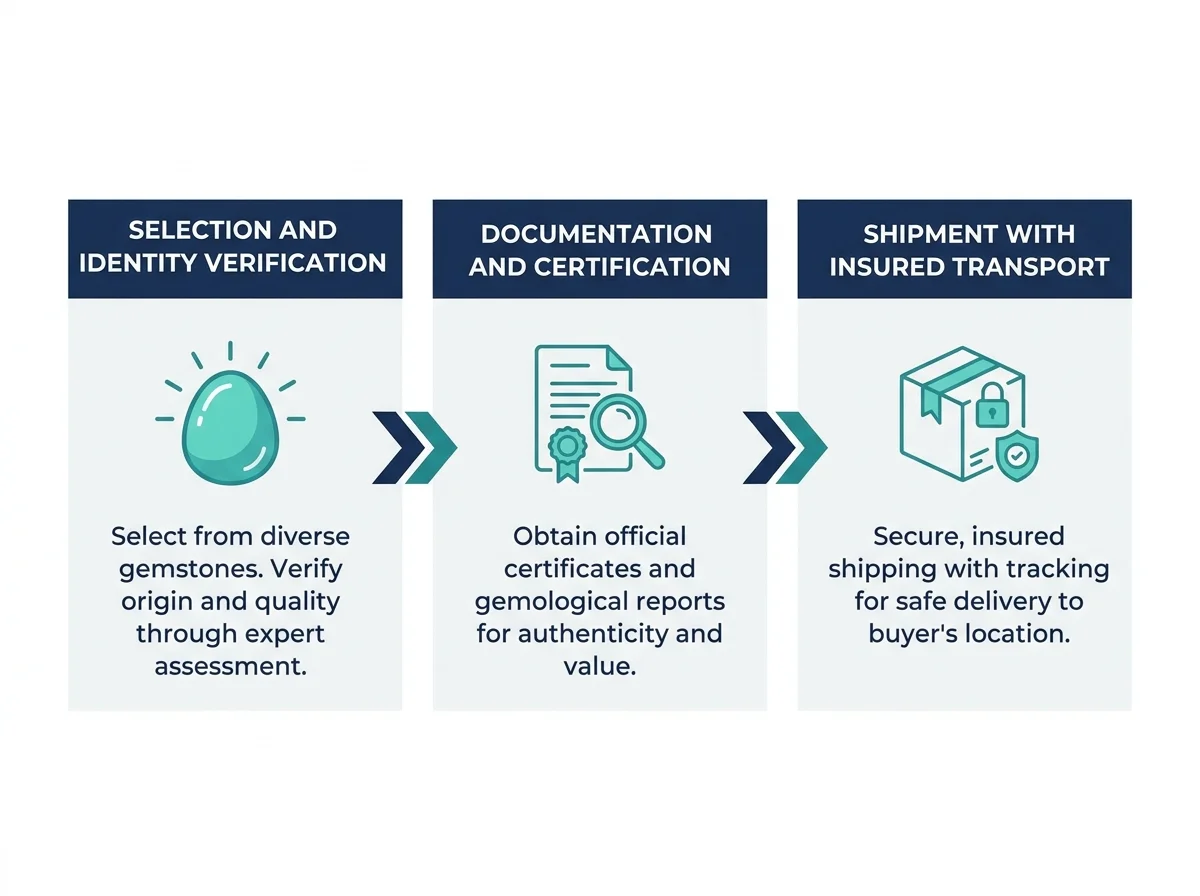
Business Recorder reports that the policy proposes a statutory National Gemstone Authority, a National Warranty Office to standardise inspection, valuation, certification and sealing of export consignments, minimum export price benchmarks, Pakistan-specific HS codes and a National Gemstone Business Registry. For international buyers, this suggests that documentation and certification practice is likely to become more formal over time. These measures are proposals whose rollout will take time, so ask suppliers what they currently provide rather than assuming any rule is already in force.
On the demand side, Daa Minerals groups buyer enquiries into four regional focus areas on its Global Markets page: the Middle East, East and South Asia, Europe, and Africa and emerging markets. The company describes these as enquiry categories, not confirmed volumes or guaranteed routes. Reliable, moonstone-specific export volume data could not be found, so none is quoted here.
Customs Classification
Gemstones fall under Chapter 71 of the Harmonized System. Heading 7103 covers precious and semi-precious stones, with separate subheadings for unworked, sawn or roughly shaped stones and for worked stones. The World Customs Organization maintains the six-digit system used by more than 200 countries and economies, and national codes add digits beyond the sixth. Because Pakistan has proposed its own gemstone-specific codes, confirm the current classification with a customs broker and keep descriptions consistent across documents.
How to Approach a Moonstone Purchase
Start with a written brief covering the form, sheen and colour preferences, transparency, size range, quantity and destination. Ask for photographs or video of the actual parcel instead of stock images, and compare the delivered goods with them. Agree delivery terms using the International Chamber of Commerce’s Incoterms rules, and link payment to evidence such as sample approval and shipping documents. Pakistani exporters file declarations through the Pakistan Single Window, so ask whether your supplier’s shipments are handled that way.
Making an Enquiry
If you are ready to discuss a requirement, use the Daa Minerals contact page to share your form, sheen and colour targets, size range, quantity and destination. The company lists moonstone in its mineral portfolio and states that availability, grade and pricing remain subject to source review, buyer approval and written agreement. You can also submit a requirement through DaaTrade.
Final Thoughts
Moonstone from Pakistan offers real opportunity, but it suits buyers who inspect carefully and document thoroughly. Understand the stone’s optical character, specify what you want, verify identity and treatment, and keep an eye on how Pakistan’s gemstone policy develops. Buyers who combine those habits with a clear brief are the most likely to build reliable supply.
Pakistani Moonstone: Frequently Asked Questions
What gives moonstone its glow?
Adularescence, caused by light scattering between thin alternating layers of orthoclase and albite within the stone.
Is all moonstone the same mineral?
No. GIA describes moonstone as a variety of orthoclase, but other feldspars such as labradorite and sanidine can also show a similar effect.
Who buys moonstone?
Jewellers, lapidaries, decorative-goods makers and collectors are the main groups, each with different quality priorities.
Are there new rules for exporting gemstones from Pakistan?
A National Gemstone Policy has been approved, with proposals on certification, valuation and registration. Ask your supplier and customs broker which steps currently apply.