Moonstone Price in Pakistan: A Buyer’s Guide to Costs and Quotations
Most people searching for moon stone price Pakistan sellers charge hope to find a table of rates. This guide deliberately disappoints on that point. A search for current, verifiable public price data on Pakistani moonstone turned up nothing worth printing, so there are no per-carat or per-kilo figures here. Gemstone prices depend on a long list of visual and commercial factors, and a number without those details is misleading. What this guide offers instead is a clear explanation of how moonstone is priced, how to read a quotation and how to request one you can actually compare.
Why Moonstone Has No Single Price
Moonstone is valued by appearance, and appearance varies enormously between stones. The Gemological Institute of America explains that moonstone’s glow, adularescence, comes from light scattering between thin layers within the stone. Its strength, colour and visibility differ from piece to piece, and so does value. GIA notes that blue sheen against a colourless background is a prized combination, which is one reason stones of the same size can be priced very differently.
The Main Factors That Drive Moonstone Prices
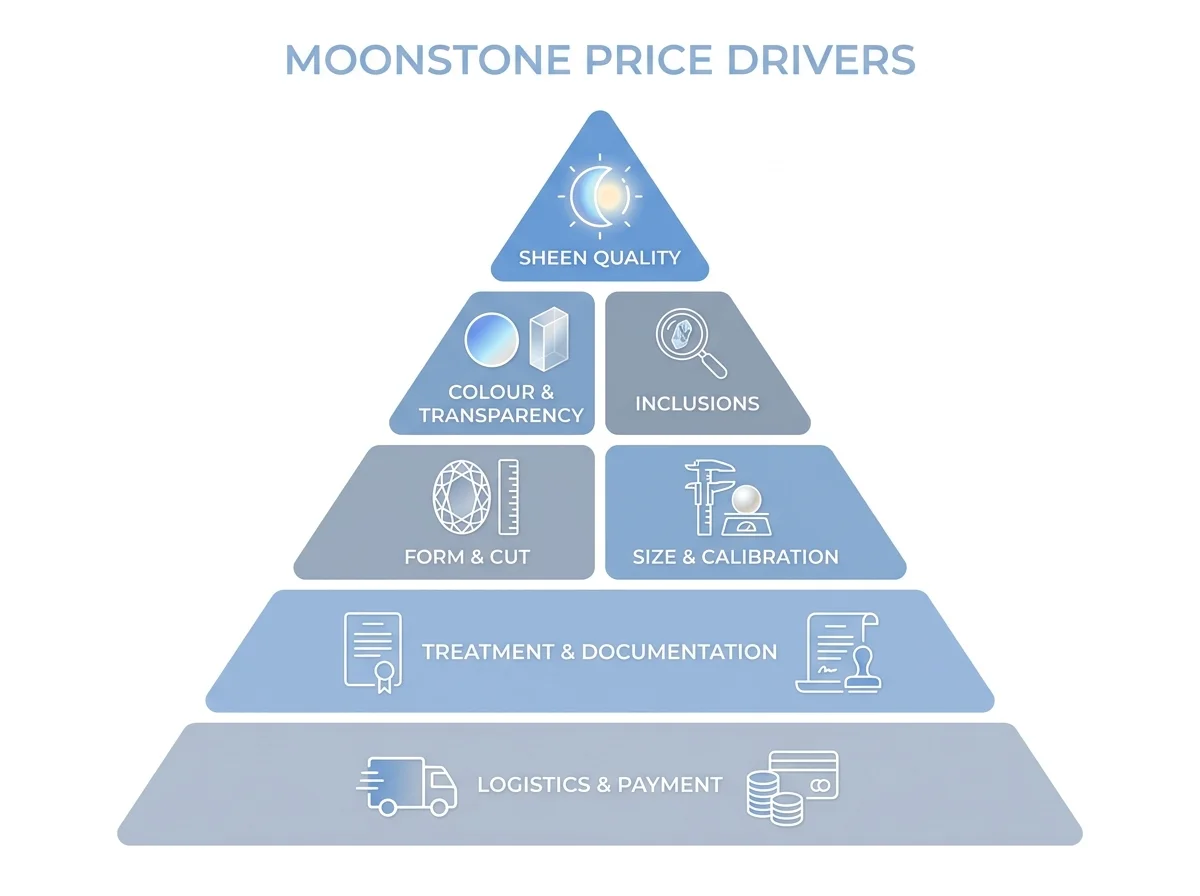
Sheen Quality
The strength, colour and visibility of adularescence are usually the most influential factor. A strong, clear sheen visible from several viewing angles generally commands more than a weak or patchy one.
Body Colour and Transparency
Colourless or very clear body colour with a vivid sheen is prized by many buyers, while other colours appeal to particular markets. Transparency affects how the sheen appears and how the stone looks once cut.
Inclusions and Surface Condition
Visible inclusions, cracks and surface damage reduce usable yield in rough and affect finished appearance. Daa Minerals says it reviews inclusions and surface condition as part of its moonstone assessment.
Form: Rough, Cabochon or Finished
Rough costs less to prepare than cut stone, but you carry the yield risk. Cabochons and finished stones include cutting and polishing labour, and their price reflects the skill of the cut. GIA notes that a quality cut maximises the shimmer, so craftsmanship affects value directly.
Size, Shape and Calibration
Larger stones with good sheen are rarer, and calibrated sizes that fit standard settings can carry a premium because they save the jeweller work. Free sizes usually price differently.
Quantity and Consistency
Large parcels need consistent quality, and assembling a uniform lot takes sorting effort. Unit price often reflects how tightly the parcel is graded.
Treatment and Documentation
Whether stones are treated, and whether an independent report accompanies them, can change both value and the cost of the transaction. Reports are issued by the laboratory, not the supplier, so agree the scope and provider in advance.
Logistics, Insurance and Payment
Gemstones are small and valuable, so secure packing and insured transport matter. Delivery terms, payment method and currency exposure all influence the final price.
How to Read a Moonstone Quotation
A price means little without the details around it. When quotations arrive, check:
1. Whether the parcel is rough, cabochon or finished
2. The description of sheen, colour and transparency, ideally with reference photographs
3. Size or weight range and calibration
4. Treatment disclosure
5. Unit of sale, such as per carat, per piece or per kilogram, and the currency
6. Delivery term, named delivery point and insurance
7. Packaging, documentation and testing included or excluded
8. Validity period
If any of these differ between suppliers, the figures cannot be set side by side. The International Chamber of Commerce’s Incoterms rules are a useful reference for the delivery term, since they clarify who handles tasks, costs and risks between seller and buyer.
Comparing Two Offers Fairly
Imagine one supplier is far cheaper. Before treating that as a win, ask whether the stones have the same grade of sheen, whether the parcel is truly uniform, whether treatment is disclosed and whether insurance and documents are included. A low price on loosely described goods is not a saving if the parcel disappoints. A clear way to compare is to approve a reference sample from each supplier and ask them to quote the same selection standard, with the sample sealed and labelled.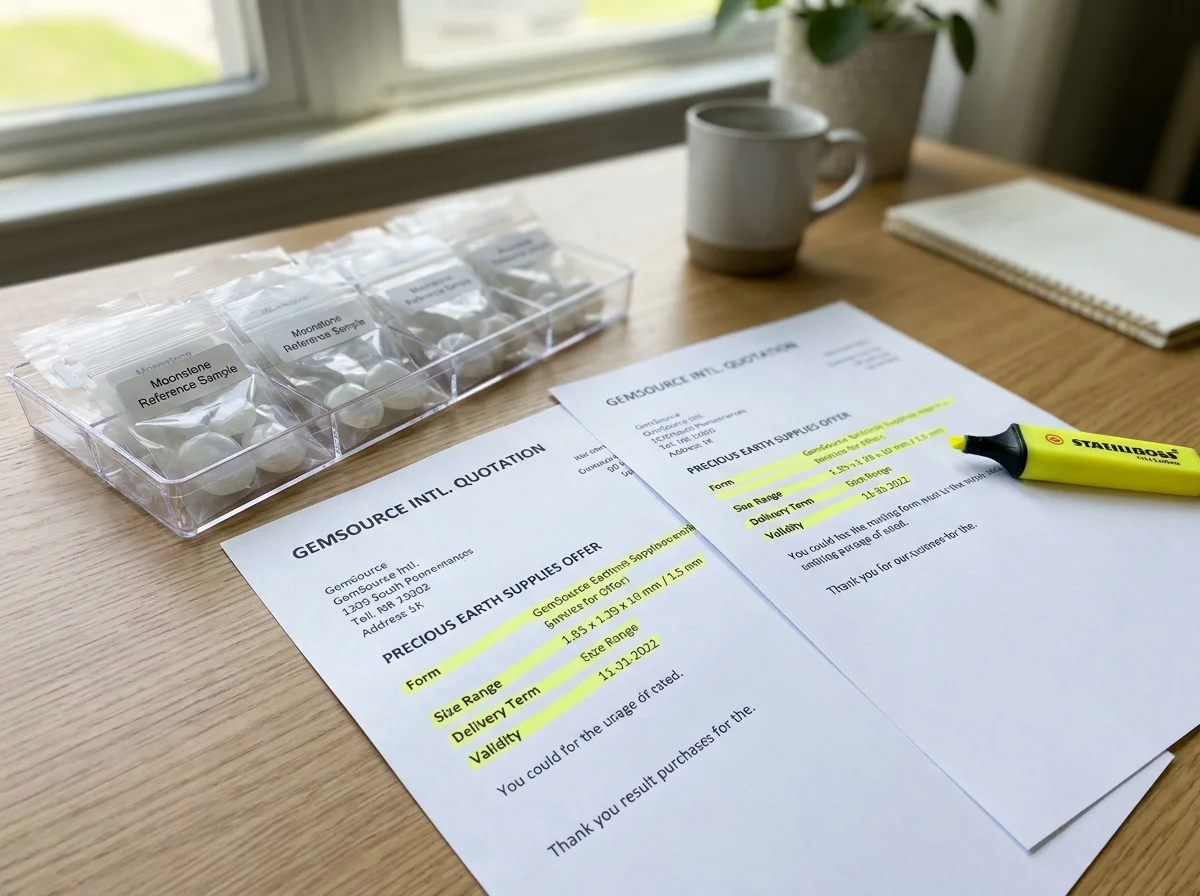
Policy Developments That May Affect Pricing
Pakistan’s gemstone sector is being reshaped. Business Recorder reports that the government-approved National Gemstone Policy introduces minimum export price benchmarks, Pakistan-specific HS codes and a National Warranty Office to standardise inspection, valuation, certification and sealing of export consignments. The aim, according to the report, is to curb under-invoicing and improve data integrity.
For buyers, this means the way gemstones are valued and documented for export may become more formal. These are policy measures whose rollout will take time, so do not assume any benchmark is already in force. Ask each supplier how they currently value and document their shipments, and expect that the answer may change.
Costs Beyond the Headline Price
Several costs often appear after the price is agreed: laboratory reports, insurance, secure courier or freight, customs charges at destination, and bank fees. Gemstones fall under heading 7103 of the Harmonized System, with separate subheadings for unworked or roughly shaped stones and for worked stones. The World Customs Organization maintains the six-digit system used by more than 200 countries and economies, and national duty rates apply to the codes your customs broker confirms. Getting the classification right avoids delays that turn into costs.
How to Request a Quote You Can Compare
Send the same brief to every supplier. Include form, sheen and colour targets, transparency, size or weight range, quantity, treatment requirements, packaging, destination and delivery term, and the documents or reports you need. Ask them to quote on the same basis and to state what is included. The Daa Minerals contact page lists similar inputs and notes that response depends on how clear the requirement is.
Red Flags in Moonstone Pricing
Be cautious about prices far below every other quotation for supposedly identical goods, quotations that do not describe the stones, sellers who will not disclose treatment, and requests for full prepayment before any verification. Be equally careful with catalogue photographs that do not match the parcel offered. Ask for images or video of the actual lot.
Getting an Actual Quote
To move from research to a real figure, share your requirement through the Daa Minerals contact page. The company lists moonstone in its mineral portfolio and states that pricing, availability and shipment timing remain subject to source review, buyer approval and written agreement. You can also use the DaaTrade buyer requirement form.
Final Thoughts
Moonstone price in Pakistan is the product of sheen, colour, clarity, form, size, documentation and delivery terms, not a single market rate. Write down what you need, ask every supplier to quote on the same basis, and weigh price against evidence and risk. A well-defined brief is the surest way to receive a quotation worth acting on.
Moonstone Pricing: Frequently Asked Questions
Can I find a standard moonstone price per carat for Pakistan?
Not reliably. Price depends on sheen, colour, clarity, form, size and terms, so a meaningful figure needs your specification.
Why are moonstone quotations so different?
They often describe different qualities, forms or delivery terms. Compare the descriptions and inclusions before comparing numbers.
Does the price include a gemmological report?
Only if the quotation says so. Reports are issued by laboratories and should be requested and priced separately.
Will the new gemstone policy change prices?
It proposes minimum export price benchmarks and stronger valuation and certification, but implementation will take time. Ask suppliers what applies today.