
IRRI-6 vs IRRI-9 Rice: Differences, Uses and Export Markets
Buyers who look beyond premium basmati usually end up comparing two names from Pakistan's non-basmati range: IRRI-6 and IRRI-9. Both are exported in large volumes, both cost considerably less than basmati, and both supply well-established markets across Africa, the Middle East and Asia. They are not the same product, though, and the differences affect which one suits a given market or end use.
This guide compares IRRI-6 and IRRI-9 rice on grain size, growing regions, cooking behaviour, export destinations and grades, and lists the specifications worth requesting before you place an order.
What Are IRRI-6 and IRRI-9?
Both varieties trace back to the International Rice Research Institute (IRRI) in the Philippines, which began releasing high-yield varieties for tropical and subtropical conditions in the 1960s. Pakistan adopted them and has grown them at scale for decades, mainly in Sindh and Punjab.
Neither is aromatic the way basmati is. They are classified as non-basmati long-grain rice: practical, affordable and available in large volumes, which is exactly why they matter commercially.
Key Differences Between IRRI-6 and IRRI-9
Grain Size and Appearance
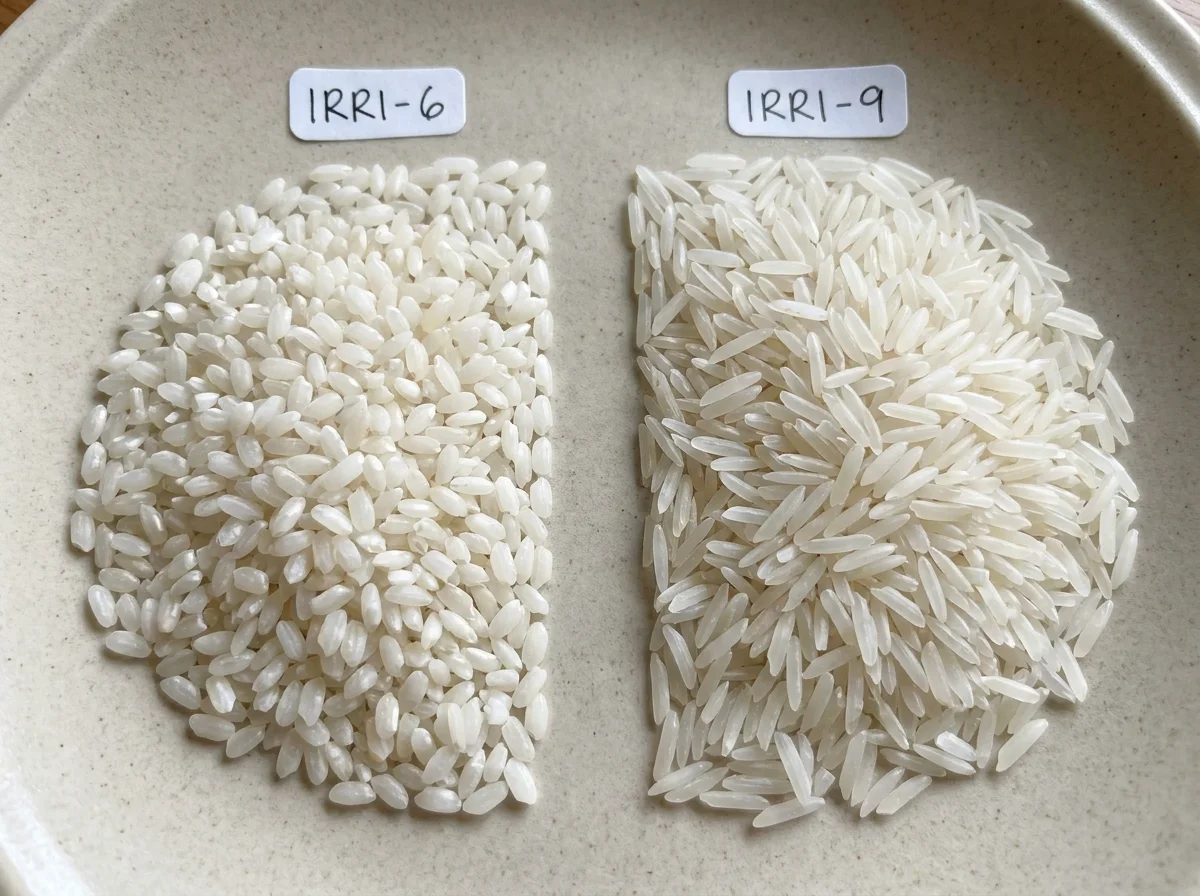
IRRI-6 has a slightly shorter, broader grain, with an average length of roughly 6.0 to 6.6 mm. It has a relatively high bulk density, which gives it a compact, firm look.
IRRI-9 is longer and slimmer, typically around 6.6 to 7.0 mm, with a length-to-width ratio close to 4:1. That slender shape gives it a more premium appearance than IRRI-6.
Growing Regions
IRRI-6 is grown mostly in Sindh, in districts such as Larkana, Jacobabad, Badin and Thatta, and to a lesser extent in Punjab. IRRI-9 is cultivated in both Punjab and Sindh. Soil conditions and water availability in a given crop year can subtly affect quality and consistency, so it is worth asking which region a lot comes from.
Texture and Cooking Behaviour
IRRI-6 cooks into softer, slightly stickier grains and absorbs water readily. That suits everyday dishes in markets where a softer, more cohesive texture is acceptable or preferred.
IRRI-9 stays a little firmer after cooking and holds its shape better. The slender grain also gives finished dishes a cleaner presentation.
Export Markets for IRRI-6 and IRRI-9
The two varieties serve somewhat different trade flows, although they overlap.
• IRRI-6: Exported mainly to African markets, including Kenya, Mozambique, Nigeria, Cameroon and Tanzania, as well as the Middle East (particularly the UAE and Iran) and parts of Southeast Asia such as Bangladesh and the Philippines. It is well established wherever price is the main buying factor and large volumes are needed.
• IRRI-9: Also strong in Middle Eastern and African markets, but it tends to attract buyers who want a longer, cleaner-looking grain and will pay a modest premium over IRRI-6. Its slimmer profile looks closer to long-grain basmati, which helps in retail presentation.
Broken Percentages and Grades
Both varieties are traded in several broken grades, and the grade is one of the biggest factors in price.
• 5% broken: Export grade with the lowest broken content and the highest quality. Suitable for premium non-basmati retail and mid-range food service.
• 25% broken: A mid-grade commonly traded in bulk for institutional and catering supply, at a significant cost saving compared with 5% broken.
• 100% broken: Used in flour milling, animal feed and food processing. Very competitively priced, and Pakistan exports meaningful volumes of it every year.
Always state the broken percentage clearly in a procurement enquiry. It determines both the price and the appropriate end use.
Specifications to Request
For standard export-grade IRRI-6 or IRRI-9, ask for a Certificate of Analysis (COA) that confirms moisture content (maximum 14%), broken grain percentage, foreign matter (nil) and sortex cleanliness. A phytosanitary certificate is needed for all markets, and some importing countries add their own fumigation or treatment requirements.
Saremco Impex supplies IRRI-6 and IRRI-9 rice from Pakistan in a range of grades and broken percentages. Bulk sourcing enquiries are welcome at saremcoimpex.com.