
Pakistan holds documented hard-rock lithium occurrences across Gilgit-Baltistan and Balochistan, with exploration-stage sites recorded in several provincial mineral registers. Global demand for lithium from battery manufacturers, energy storage developers, and advanced materials producers has risen sharply in recent years, driven by published procurement targets and price signals tracked by agencies such as the International Energy Agency (IEA). Yet the gap between "Pakistan has lithium" and "I have received a verified, specification-matched shipment" is wider than most directory searches suggest.
If you are asking where you can buy lithium ore from Pakistan, the honest answer is: through channels that can demonstrate mining rights, provide third-party assay certificates, and handle export documentation correctly. Supplier verification is genuinely difficult. Regulatory changes have tightened the conditions under which raw minerals can leave the country. And grade claims in online listings vary so wildly that without independent analysis, a buyer has no rational basis for committing capital.
This guide covers the practical ground: what Pakistani lithium ore actually looks like, where it originates, how to identify credible supplier channels, what pricing benchmarks to use, what export documentation is required, and how to move from an initial enquiry to a confirmed shipment. Some firms offer end-to-end coordination services rather than raw brokerage, and that distinction matters. We will explain why as we go.
What Pakistani Lithium Ore Actually Looks Like
Spodumene and Lepidolite: Knowing Which Mineral You Are Buying
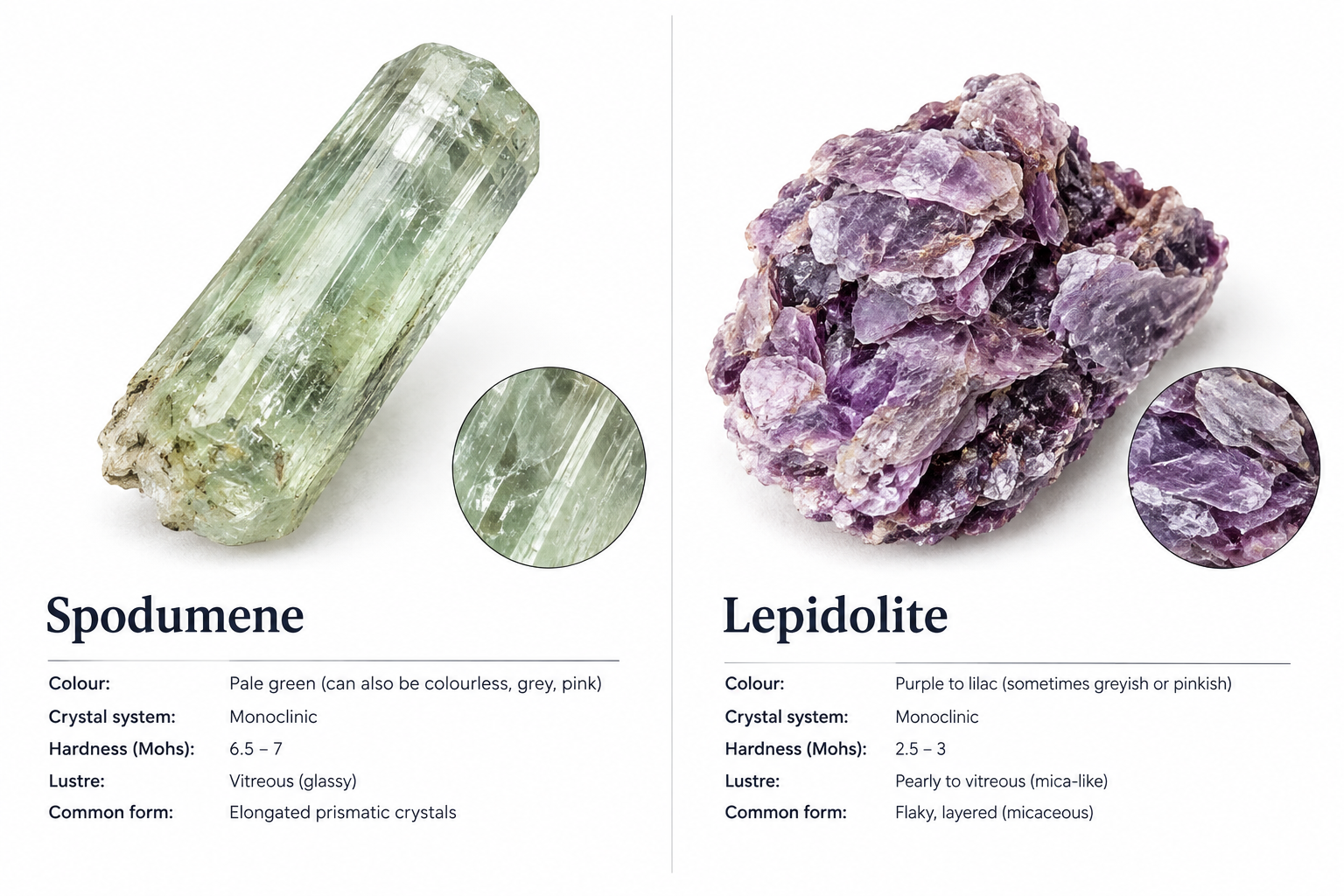
Two primary lithium-bearing minerals appear in Pakistan's market. Spodumene, a pyroxene mineral, is the commercially dominant form globally and carries Li₂O directly in its crystal structure. Lepidolite, a mica-group mineral, also appears in Pakistani listings but is less preferred for battery-grade processing because of its more complex downstream chemistry. Before any price discussion begins, confirm which mineral form is on offer. Processing routes, pricing, and buyer acceptance criteria differ substantially between the two.
Grade Specifications and How to Read a Lab Certificate
The core assay parameters are the headline Li₂O percentage, moisture content, and key impurities including Fe, Na, K, Ca, Mg, and Si. Run-of-mine ore from Pakistani deposits typically assays in the 1–3% Li₂O range, with most reported samples falling closer to 1–2% Li₂O. Spodumene concentrate prepared for downstream processing sits around 5–7% Li₂O, commonly referenced as SC6 (approximately 6% Li₂O) in commercial trade. A standard commercial-grade specification for spodumene concentrate often targets 7.2% Li₂O with Fe below 0.135%, Na below 0.16%, and K below 0.11%.
A credible certificate of analysis lists analyte-by-analyte results, the analytical method used (ICP-OES, XRF, or XRD), detection limits, and the issuing laboratory's name and accreditation details. SGS Pakistan, which holds PNAC accreditation for ores and minerals, is one benchmark for what a proper report looks like. A scanned screenshot attached to a marketplace listing is not the same as a verified third-party report. Treat any certificate that lacks a traceable issuing lab as unverified until confirmed otherwise.
What Realistic Grade Expectations Look Like from Pakistani Deposits
Published sample reports from Pakistani localities have returned figures such as 2.86% Li₂O and 5.92% Li from specific sites. Wide grade variation between listings is normal for a market with diverse geological origins and inconsistent preparation standards. Do not use the highest-grade listing you encounter as a basis for purchase without independent assay confirmation on your specific parcel.
Where Can I Buy Lithium Ore from Pakistan? Understanding Origins and Port Routes
The Key Mining Regions: Gilgit-Baltistan, Balochistan, and KPK
Gilgit-Baltistan has active title-holders and licence applications under the provincial GB Mining Concession Rules, with at least one documented lithium applicant in Skardu at the medium-scale exploration stage. Balochistan and KPK contain known mineral belt occurrences. The origin region matters for three reasons: logistics cost, regulatory jurisdiction (provincial mineral departments control licensing), and inland freight distance to the export port.
Inland trucking from Gilgit-Baltistan to Karachi or Port Qasim covers roughly 1,800–2,000 km on mountain and highway roads, which places logistics costs in an entirely different bracket from a Balochistan site 500–600 km from port. Buyers should request the mine-site coordinates and calculate inland haulage as a separate line item before comparing FOB prices from different sellers.
Port Logistics: Port Qasim, Karachi, and the Shipping Route
Bulk lithium ore exports move through Port Qasim, which has a dedicated Iron Ore and Coal Berth with a design capacity of 3.03 million tonnes per annum, and through Karachi Port for general bulk cargo. Goods travel from inland mine sites to port primarily by truck, with rail an option for some inland corridors. Ocean routing runs direct or via transshipment hubs at Jebel Ali, Colombo, or Singapore depending on the destination market and carrier schedule.
Budget for these cost layers separately: inland haulage, port handling and wharfage, documentation charges, vessel freight, and insurance. An FOB price per tonne from a Pakistani seller does not reflect the total landed cost. Comparing FOB quotes without knowing the inland freight element is not a reliable basis for supplier selection.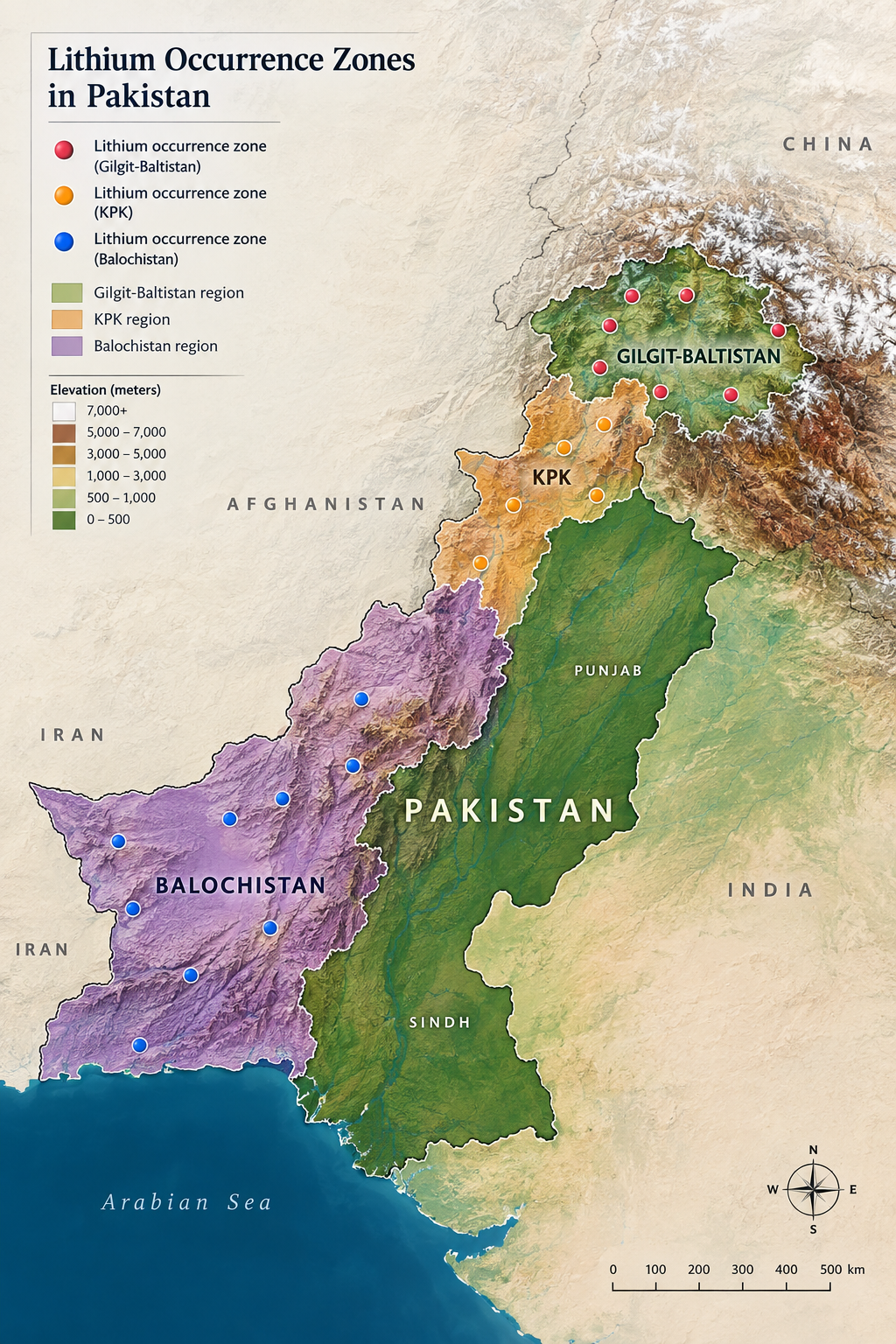
Finding and Verifying Legitimate Lithium Ore Suppliers in Pakistan
What Supplier Channels Are Worth Trusting
B2B marketplace listings surface names and city locations but rarely provide independently verified business credentials or traceable mining rights. Buyers searching these platforms will encounter a mix of genuine exporters, individual traders, and aggregators who have no direct mine access. The practical risk is straightforward: a supplier who cannot show a valid provincial mining lease or exploration licence has no defensible, documented source for the material they are offering. Knowing where to buy lithium ore from Pakistan starts with knowing which channels can produce this documentation on request — and which cannot.
Red Flags That Signal Unverified Brokers
Be specific about what to watch for. Sellers with no verifiable mine title or licence documentation, and lab certificates presented only as screenshots without issuing lab contact details, are immediate warning signals. Grade claims that significantly exceed publicly known deposit averages and pricing below any realistic market benchmark raise concerns. Taken together, these indicators point to a broker with no material — not a supplier with a parcel ready to ship.
Also note that some directory listings show suppliers located in cities or provinces with no documented lithium occurrences. A Lahore-based listing for lithium ore deserves a more sceptical eye than one from Skardu or a Balochistan mining district. The question to ask every prospective supplier is simple: show me the mining lease or exploration licence for the source area.
Why a Structured Coordination Model Changes the Equation
Daa Minerals Limited operates differently from a raw broker. We take the buyer's grade, quantity, material form, and destination requirements in writing, source material through verified supplier channels, coordinate third-party testing upon buyer request, and manage export documentation under a defined commercial scope. For international buyers unfamiliar with Pakistan's supply landscape, this removes the need to manage multiple uncoordinated relationships across sourcing, testing, documentation, and logistics. Counterparty risk drops substantially when the engagement is structured and documented rather than informal and verbal.
Pricing Benchmarks and What to Expect Per Tonne
Current Spodumene Concentrate Price Ranges
Pakistani-origin lithium ore is not quoted transparently on public pricing platforms. The most defensible reference point for buyers is the global benchmark for spodumene concentrate at 6% Li₂O. According to Benchmark Mineral Intelligence and CRU pricing data, global spodumene concentrate traded in the approximate range of USD 2,038–2,357 per tonne on FOB Australia and CIF China terms through mid-to-late 2026. Use these as anchor figures, then factor in grade adjustments, freight differential from Pakistan to the destination, and supplier margin.
What Drives Price Variation in Pakistani Listings
Four variables drive the actual price for a given parcel:
Li₂O grade — the primary driver. Lower-grade ore at 1–4% Li₂O commands substantially less than concentrate-grade material near 6–7%.
Material form — sized and washed concentrate commands a premium over run-of-mine ore.
Moisture content — affects transportable weight and processing cost.
Third-party assay availability — whether the seller can supply a credible third-party assay affects how much a buyer can justify paying without taking on unknown quality risk.
A USD 1,100 listing for unspecified "lithium ore" on a directory site, with no stated grade, no tonnage basis, and no port terms, is not a market price. Do not use it as a buying benchmark or as a negotiating anchor against verified-grade material. The two are not comparable products.
Export Documentation and Pakistan's Regulatory Requirements
Pakistan's Recent Restrictions on Raw Mineral Exports
This section carries the most operationally critical information for any buyer planning a direct purchase. Pakistan's Senate Standing Committee on Commerce has approved a policy direction to restrict the export of raw metallic and non-metallic minerals, with exceptions for G2G arrangements under the SIFC (Special Investment Facilitation Council) framework, a position documented in Senate committee records and Ministry of Commerce communications. This approval represents a significant policy step, though full statutory enactment may require further regulatory instruments. Lithium has been specifically identified as a "precious mineral" for which the federal government is to prescribe the manner of export. The National Minerals Harmonisation Framework 2025 is simultaneously reshaping licensing and regulatory conditions across the sector.
Buyers cannot assume that standard mineral export procedures apply to lithium. The regulatory position is actively evolving. Verify the current status of any applicable export authorisation before structuring a transaction — not after.
Essential Documents for a Compliant Lithium Ore Shipment
A correctly assembled export document set includes:
WEBOC registration and a customs export declaration (Goods Declaration)
Commercial invoice
Packing list
Bill of lading
Certificate of origin
Any government-prescribed authorisation specific to lithium or raw minerals
The applicable Pakistan Customs tariff heading for lithium ores and concentrates — including spodumene, lepidolite, petalite, and similar minerals — falls under PCT/HS code 2530.90.40 (spodumene, petalite, lepidolite, amblygonite, hectorite, jadarite and similar minerals suitable for the extraction of lithium). Confirm this classification against the current tariff before filing, as schedules are subject to amendment.
The Compliance Reality for International Buyers
A seller who cannot demonstrate active mining rights, exporter registration, and clarity on the current lithium export authorisation requirements is a compliance risk for the buyer as well as for themselves. Import-side customs authorities in buyer countries will scrutinise documentation on lithium shipments precisely because of the strategic material designation this mineral now carries in most jurisdictions. Structure the transaction with full documentation from the outset — not as an afterthought once the cargo is ready to move.
Moving from Enquiry to Shipment: The Practical Next Steps
Requesting Samples and Commissioning Independent Analysis
Before any bulk order discussion, request a representative physical sample and commission assay testing through an independent third-party laboratory. SGS Pakistan, accredited by PNAC for ores, rocks, and minerals, is one credible option on the Pakistan side. Buyers can verify accreditation status through the PNAC accreditation directory directly. The analysis should cover Li₂O, moisture, and the full impurity panel relevant to your processing requirements, using ICP-OES as the primary method. A seller who resists independent sampling or offers only an in-house test report is signalling that the grade claim cannot survive external scrutiny.
Third-party inspection coordination — where both parties agree in writing to the scope, lab selection, and cost allocation — is standard in professionally structured transactions. If a supplier pushes back on agreed, written inspection terms, that response tells you something important before you have spent anything on logistics.
Structuring Your First Order
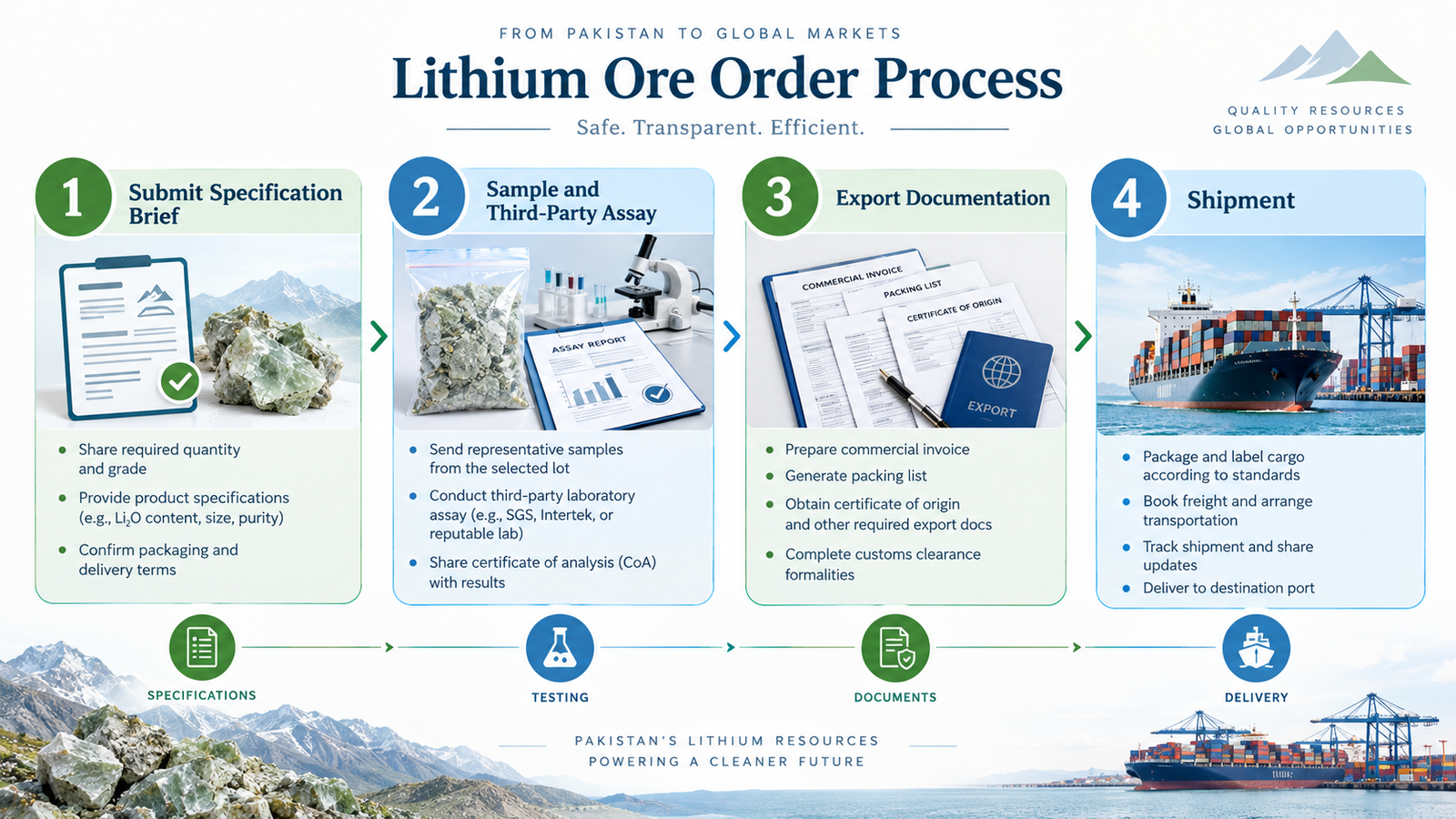
A properly structured first order specifies grade, quantity, material form, Incoterms, port of loading, and any preparation requirements such as sizing, drying, or packaging. Buyers working with a coordination partner such as Daa Minerals Limited can submit their full requirement brief upfront. Sourcing, preparation, third-party verification, documentation, and shipment planning are managed under one commercial framework rather than across multiple uncoordinated relationships.
Submit a specification brief, request a sample against that specification, and build from confirmed assay results before committing to volume. That sequence protects capital and removes the ambiguity that causes most Pakistan mineral transactions to stall or fail.
The Buyer's Position in a Maturing but Complex Market
Pakistan's lithium deposits are real. Interest from international buyers seeking to source lithium ore from Pakistan has grown alongside global price signals and battery-supply chain diversification. The barrier for most international buyers is not access to Pakistan's minerals — it is navigating a supply chain that lacks the transparency they are accustomed to in more mature mineral markets. Raw lithium ore shipments from Karachi and lithium concentrate from Pakistan's mining districts are achievable, but only through channels with the required documentation.