 Organic Agriculture Inputs
Organic Compost
Organic compost from Pakistan. Farmyard compost and vermicompost. For...
Inquire Now
Find minerals, agricultural goods and more
Pakistani organic compost in farmyard compost and vermicompost forms for agriculture and horticulture
Organic compost from Pakistan. Farmyard compost and vermicompost. For soil improvement, organic farming and horticulture. Price on inquiry, shipped from Karachi.
Organic compost is produced by the biological decomposition of organic matter under controlled aerobic conditions. The composting process converts raw agricultural waste, livestock manure, and other organic inputs into a stable, humus-rich soil amendment that releases nutrients slowly, improves soil physical properties, and supports beneficial soil microbiology. Pakistan’s large agricultural and livestock base provides abundant, low-cost feedstock for both farmyard compost and vermicompost production.
Farmyard Compost (FYC)
Material: Composted livestock manure (cattle, buffalo, poultry) blended with crop residues (wheat straw, rice straw, corn stalk)
Composting Method: Windrow or static pile, thermophilic (60-70°C peak), 8-12 weeks
Organic Matter: 25-35%
Nitrogen (N): 1.0-1.5%
Phosphorus (P₂O₅): 0.5-1.0%
Potassium (K₂O): 0.8-1.5%
C:N Ratio: 15-20:1
pH: 6.5-7.5
Moisture: 25-35%
EC: 2-5 dS/m
Humic Acid: 3-8%
Pathogen Status: Pathogen-free (thermophilic composting eliminates E. coli, Salmonella, weed seeds)
Colour: Dark brown to black
Texture: Coarse, fibrous, crumbly
Vermicompost
Material: Worm-processed organic waste (livestock manure, vegetable waste, crop residues)
Composting Method: Eisenia fetida (red wiggler) earthworms, 45-60 days
Organic Matter: 30-45%
Nitrogen (N): 1.5-2.5%
Phosphorus (P₂O₅): 1.0-2.0%
Potassium (K₂O): 1.0-2.0%
C:N Ratio: 12-15:1
pH: 6.5-7.5
Moisture: 25-35%
EC: 1-3 dS/m
Humic Acid: 5-12%
Beneficial Microbes: > 10⁸ CFU/g (bacteria, fungi, actinomycetes)
Plant Growth Hormones: Contains natural auxins, gibberellins, cytokinins
Pathogen Status: Pathogen-free
Colour: Dark chocolate-brown to black
Texture: Fine, granular, crumbly, earthy smell
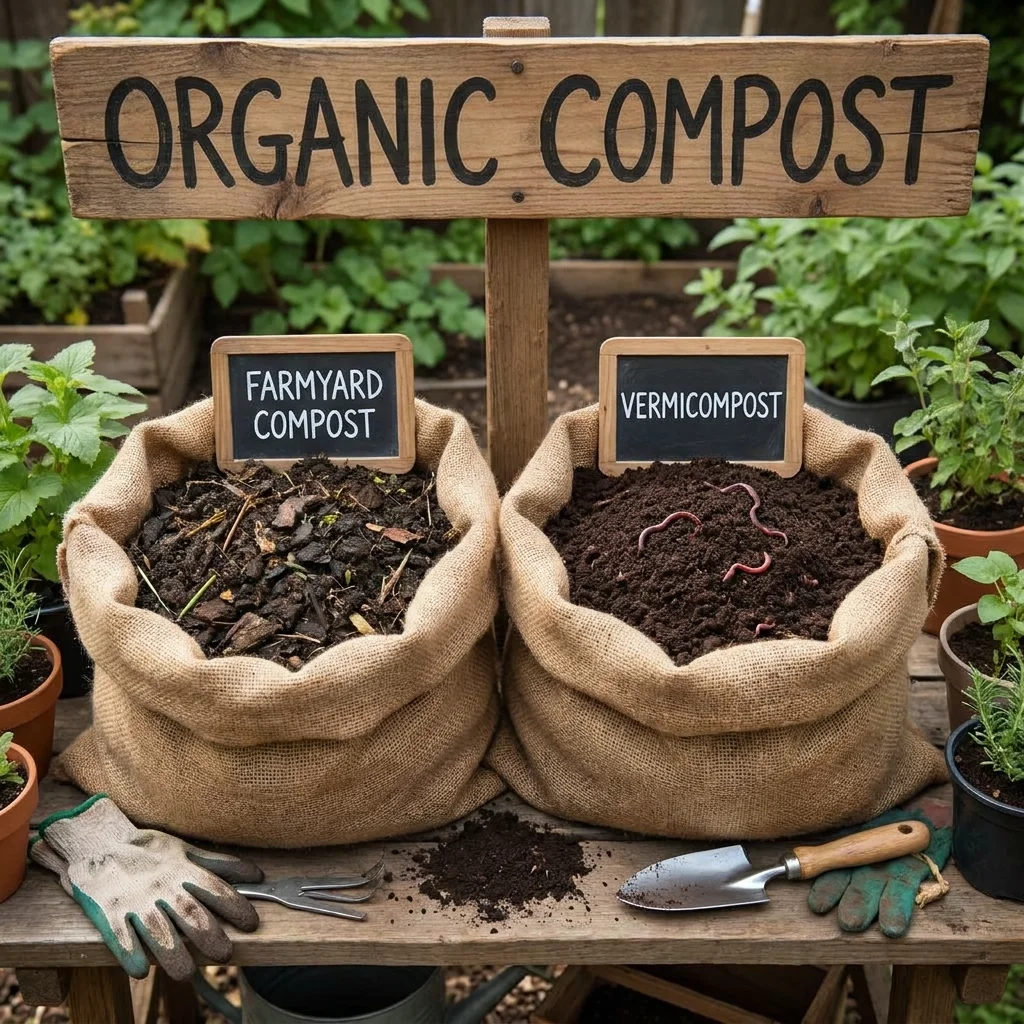
Farmyard Compost
Produced through traditional thermophilic composting of livestock manure (cattle, buffalo, or poultry) mixed with carbon-rich crop residues (wheat straw, rice straw, corn stalk). The raw materials are piled into windrows, maintained at 60-70°C through regular turning and moisture management for 8-12 weeks. The thermophilic temperatures kill pathogens, weed seeds, and parasites, producing a stable, safe, nutrient-rich product. Farmyard compost is the most widely used and affordable organic soil amendment, suitable for broad-acre farming, fruit orchards, vegetable fields, and general soil improvement.
Vermicompost
Produced by feeding pre-composted organic waste through earthworm beds (primarily Eisenia fetida, the red wiggler). The worms digest the organic matter and excrete castings (vermicast) that are richer in plant-available nutrients, humic acids, beneficial microorganisms, and natural plant growth hormones than conventional compost. Vermicompost is the premium organic soil amendment, with higher NPK values, finer texture, lower C:N ratio, and documented plant growth-promoting effects. It is preferred for high-value horticulture, nurseries, greenhouse production, organic farming, and premium landscaping.
Farmyard Compost:
Broad-acre agriculture: Applied at 5-10 tonnes per hectare to improve soil organic matter, water-holding capacity, and nutrient cycling in wheat, rice, cotton, sugarcane, and other field crops
Fruit orchards and vineyards: Ring application around fruit trees and vine rows to improve root zone soil structure and provide slow-release nutrition
Vegetable farming: Base fertilizer and soil conditioner for vegetable beds, improving tilth, drainage, and nutrient availability
Soil reclamation: Applied to degraded, saline, and eroded soils to restore organic matter, improve structure, and re-establish biological activity
Landscaping and turf: Top-dressing and base preparation for lawns, sports turf, parks, and landscape installations
Composted manure for organic certification: Properly composted farmyard manure is an approved input for organic farming under USDA NOP, EU Organic, and IFOAM standards
Vermicompost:
Nurseries and greenhouses: Mixed into potting media at 10-30% to improve seedling vigour, root development, and transplant survival
Organic farming: Premium soil amendment for certified organic crop production, providing slow-release NPK, humic acids, and beneficial microbes
High-value horticulture: Vegetable, herb, flower, and strawberry production where plant growth promotion and soil health are critical to yield and quality
Home gardening and urban farming: Retail-packed vermicompost for home gardeners, balcony farms, and community gardens
Turf and landscaping: Premium top-dressing for golf courses, sports fields, and high-end landscape installations
Seed germination media: Vermicompost blended with coir or peat improves germination rates and seedling quality
Foliar spray (vermi-tea): Vermicompost is steeped in water to produce vermi-tea, a liquid biofertilizer and foliar spray that delivers nutrients and beneficial microbes directly to plant leaves
Each batch is tested for organic matter, NPK, C:N ratio, pH, EC, moisture, humic acid, heavy metals (Pb, Cd, As, Hg), E. coli, Salmonella, and weed seed viability. Vermicompost is additionally tested for beneficial microbial count and plant growth hormone presence. All compost is produced from known-source organic inputs with no synthetic chemicals, pesticides, or industrial waste. Pre-shipment samples are provided for buyer evaluation.
Detailed specifications are available on request. Send us your requirement and our export desk will share them.
Bulk packaging:
25 kg or 50 kg woven polypropylene bags, palletized and shrink-wrapped
1 MT jumbo bags
Loose bulk in trucks (domestic delivery)
Retail and private label packaging:
1 kg, 2 kg, 5 kg, 10 kg, 25 kg retail bags (PP, kraft paper, jute)
Custom packaging design, printing, and branding available
Private label services for garden centre and retail brands
Loading port: Karachi Port or Port Qasim. Containerized shipment. Typical load: 20-24 MT per 20ft container (in bags). Compost must be shipped at controlled moisture (25-35%) to prevent anaerobic conditions during transit. Incoterms: FOB, CFR, CIF. Documents: Commercial Invoice, Packing List, Certificate of Origin, Certificate of Quality (nutrient analysis), Phytosanitary Certificate, Heavy Metal Analysis Report, Bill of Lading.
Organic Agriculture Inputs
Organic compost from Pakistan. Farmyard compost and vermicompost. For...
Inquire Now Organic Agriculture Inputs
Submit a Buying Requirement at DaaTrade.com
Submit Requirement